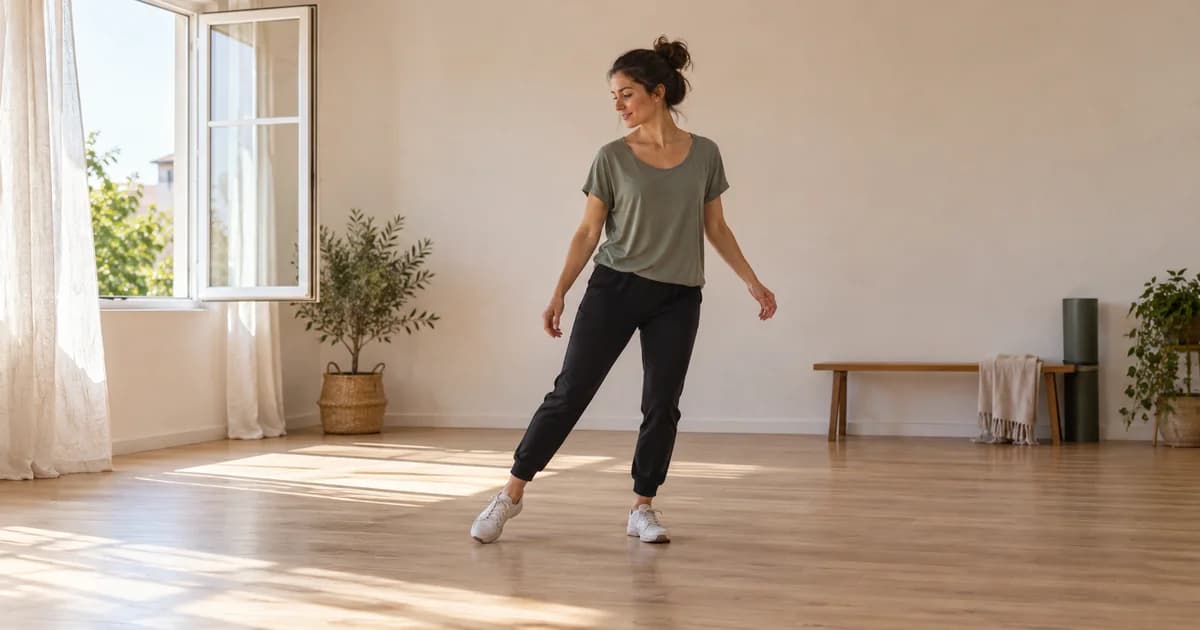
You can stop counting Bachata out loud while keeping the numbers quietly available. Try one familiar basic with a spoken count, the next with the numbers in your head, then speak again without changing your pace. If your feet hurry when your voice stops, return to the spoken count and try a smaller change.
The goal is to stay with the music and have more attention for the dance. You can use quiet numbers, a spoken reminder or no words for a passage you know. Needing the count again during a turn or an unfamiliar song is useful information about what still needs practice.
Start where the count and your feet agree
Choose a familiar song and a passage whose beat you can follow comfortably. Save quiet introductions and surprising breaks for later. Tap the pulse with your hand, count a full eight over it, then add your side basic without turns or styling.
The common beginner pattern is step, step, step, tap, then the same in the other direction. Dance Dojo's counting demonstration shows the steps on 1, 2 and 3, with a tap on 4, then steps on 5, 6 and 7, with a tap on 8. Transfer your weight on the steps; let the tap leave the other leg supporting you.
Keep the steps small enough that you can finish them without rushing across the floor. Count a few complete basics aloud. Does the voice describe the pace you hear? Do the weight changes and taps meet that pace?
If the words and feet already disagree, keep the count for now. Work on hearing the beat with the beginner musicality guide. Silence will be easier to explore once you have a starting count you trust.
Make the voice quieter, one change at a time
Stay with the same passage and basic. Try the stages below at your own pace, returning to a fuller count whenever it helps. You do not need to reach silence in one practice.
Lower the volume
Say the numbers softly or whisper them. Keep their spacing as clear as when you spoke at normal volume. You are reducing the sound, without making the count faster or squeezing the words together.
Notice whether you start holding your breath or tensing your shoulders. If you do, speak normally again, take a comfortable breath and lower the voice more gradually. You can also mouth the numbers without sound. Let the music become easier to hear while the count stays available.
Alternate a spoken and a silent basic
Try this short sequence:
- Spoken: 1, 2, 3, tap, 5, 6, 7, tap.
- Silent: keep those numbers in your head for the next complete basic.
- Spoken again: start the following basic with 1 and continue at the same pace.
Keep your feet moving evenly as the voice returns. Avoid a quick extra step to meet the next number. If the spoken count comes back earlier or later than you expected, return to the full count, tap the pulse again and try another silent basic when you feel settled.
Coming back smoothly is a helpful check for drift. It does not prove you chose the right starting beat: you can keep an even pace while the numbers remain displaced from the music. Compare your starting count with a taught example, or ask for feedback if that remains unclear.
Keep the reminder you need
Now try fewer words. If you rush the end of each group, say only "tap" on 4 and 8. If you lose your place across the whole basic, you could say "one" as the next eight begins. Keep the rest of the count inside your head if you want it.
Choose the reminder that helps with the difficulty you actually notice. You do not have to use both. If waiting for the word "tap" makes you hold back and then hurry, return to the full quiet count. The reminder should help you meet the music comfortably.
Dance a short passage without speaking
Dance a familiar passage without speaking. Keep the basic the same and listen for the pulse underneath it. The numbers may remain in your head, or you may find yourself noticing the beat without naming each one. Let either happen.
Count aloud again afterwards. Has your movement kept the pace you expected? If it has become uncertain, use the fuller count for another basic. You can keep your voice quiet for a familiar part of the song and still speak during the part that needs support.
Hear the pulse and the larger musical idea
The pulse keeps the basic moving evenly. The count helps you organise its steps and taps. Phrasing helps you recognise a musical idea finishing and another beginning. Those skills support each other, but each needs attention.
Suppose a busy guitar draws your feet towards every note. Stand still and tap the steadier pulse beneath it before adding the basic. You can hear plenty of guitar activity without changing the speed of your steps. The clearest layer may be different in another recording.
For a phrase check, listen without dancing. Tap the beat, count a familiar eight, then keep tapping quietly while you follow a vocal or guitar idea. Notice its ending and what follows. When a passage returns, see whether you recognise it while maintaining the same pulse.
A new lyric or a loud note is not a guaranteed 1. Keep the count moving through what you hear rather than restarting it at every change. The phrase-listening guide helps you compare those endings in more detail.
If the musical support drops away and you cannot follow the quiet beats comfortably, listen until you find a clear place to restart. There is no need to hurry through an uncertain passage to prove you can dance silently.
When silence reveals a difficulty
The spoken count returns early or late. Your pace may have drifted. Pause the steps, tap the pulse and count over it. Add small weight changes, then the familiar basic, before trying silence again.
The pace is even, but the starting place feels wrong. Listen without moving and compare with a taught demonstration. You may need help identifying the start or grouping, rather than more practice at removing your voice. Speeding up to reach a different number can hide the question.
The quiet basic works until a turn. Shorten the practice to basic, familiar turn, basic. Count through the transition and notice the foot available at the finish. Use a turn you have already learnt, including its exit. If that exit is unclear, ask your teacher to review it.
Another song feels harder. You may know the first recording well enough to anticipate it. Listen to the new song before moving, find its pulse and bring back the full count. The beginner playlist gives you other recordings to try.
These are clues for your next attempt, rather than definite diagnoses. Change the support or the passage first, so you can hear what helps.
Come back to it before adding more
At your next practice, try the familiar passage after getting ready to move, before repeating every stage. Notice which support is useful today: a full spoken count, quiet numbers, a word on the taps or no spoken reminder.
Keep a short note such as, "Quiet basic stayed steady; needed the count after the turn." That gives the next practice a starting point without turning it into a pass or fail test.
When the passage feels manageable, try another section, then a less familiar recording. Keep the movement familiar while the listening changes. You can return to a fuller count for each new condition.
With a practice partner, agree to keep the dance simple while you listen. Either of you can ask to count, make the movement smaller or reset. If the timing no longer feels shared, simplify together and restart comfortably. Your partner should not have to pull or push you onto the beat.
Hear your timing with another pair of ears
If you can keep an even pace but cannot tell where the basic should begin, I can listen to the same passage and watch your full-body movement in a live online Bachata lesson. We can look at visible timing, foot placement and solo transitions together. Physical partner connection still needs in-person practice with another dancer.
A specific question helps: "My basic stays steady when I count quietly, but the return after this turn sounds different." Keep the count available while we look at that moment.