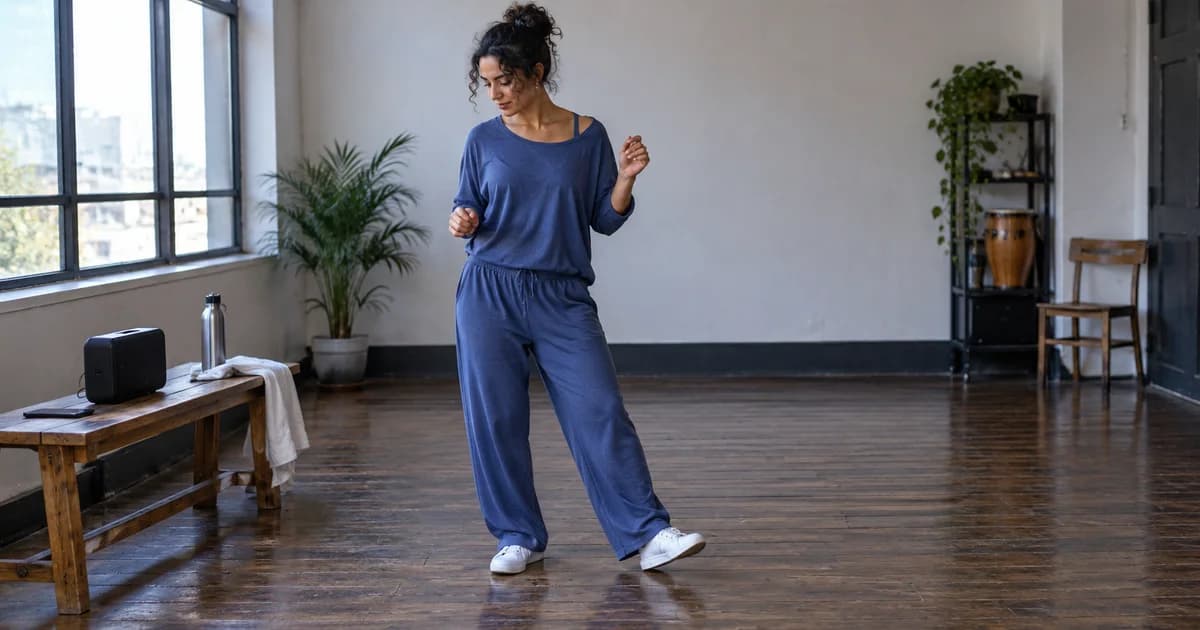
You can keep a simple basic step and still show musicality. Listen for a moment when the song softens, pauses or changes energy, then make one small choice that fits it. Start with one song you want to hear again.
I suggest listening to one layer at a time. First keep your basic step steady. Then notice a pause or a change in the guitar and choose one small movement to match it.
If timing keeps feeling unclear, the private bachata lessons guide explains when individual feedback can help. You can also work on musicality through online dance coaching.
What is the basic bachata count?
The basic bachata count is usually taught as two groups of four: step, step, step, tap, then step, step, step, tap. If you count numbers, that becomes 1, 2, 3, tap, 5, 6, 7, tap.
The numbers are where you transfer weight. The taps are where you settle, breathe, and prepare the next side. Before you try musical styling, make this count feel steady with simple side-to-side movement.
How do you find the beat?
Find the beat by listening for the steady pulse before you listen for decoration. Tap your hand first, then step the basic. If your body rushes, make the movement smaller and count aloud until your feet and the song agree.
Beginners often search for a perfect instrument to follow. That can help, but the first goal is simpler: feel where the pulse repeats. Once that is stable, the instruments become easier to separate.
Which instruments should beginners notice?
Beginners should notice the bass, guitar, percussion, and voice one at a time. The bass often gives the song weight, the guitar gives melodic lines, percussion supports timing, and the voice tells you when the emotion changes.
Do not try to respond to every layer in one dance. Pick one focus for one song. For example, dance your basic to the pulse, then use a pause when the guitar or voice creates a clear accent.
How do you hit accents without overdoing it?
You hit accents by making one clear change at the moment the music changes. The easiest beginner options are a pause, a slower step, a small body movement, or holding eye contact for one count.
Complexity is not the point. If the music has a sharp stop, stillness can be stronger than adding three movements. If the song softens, smaller steps may fit better than a dramatic shape.
What are phrase endings?
Phrase endings are moments where the musical sentence feels complete. In bachata, you may hear the singer finish a line, the guitar resolve, or the energy shift before the next section starts.
When you hear a phrase ending, you can finish your pattern, pause, breathe, or start the next basic more softly. This makes your dancing feel connected to the song instead of random.
How should beginners practice with one song?
Beginners should practice with one clear song until they can count it, step it, and notice at least three musical changes. Repeating one song teaches your ear more clearly than changing tracks every minute.
Try this: play the song once and only count. Play it again and only mark the bass or pulse. Play it a third time and pause at obvious accents. Then dance the basic and add one musical choice.
Take one choice into your next dance
Keep your basic step and try one pause where the song gives you space. If you lose the count, return to the basic. You can listen closely to the music while keeping the dancing simple.