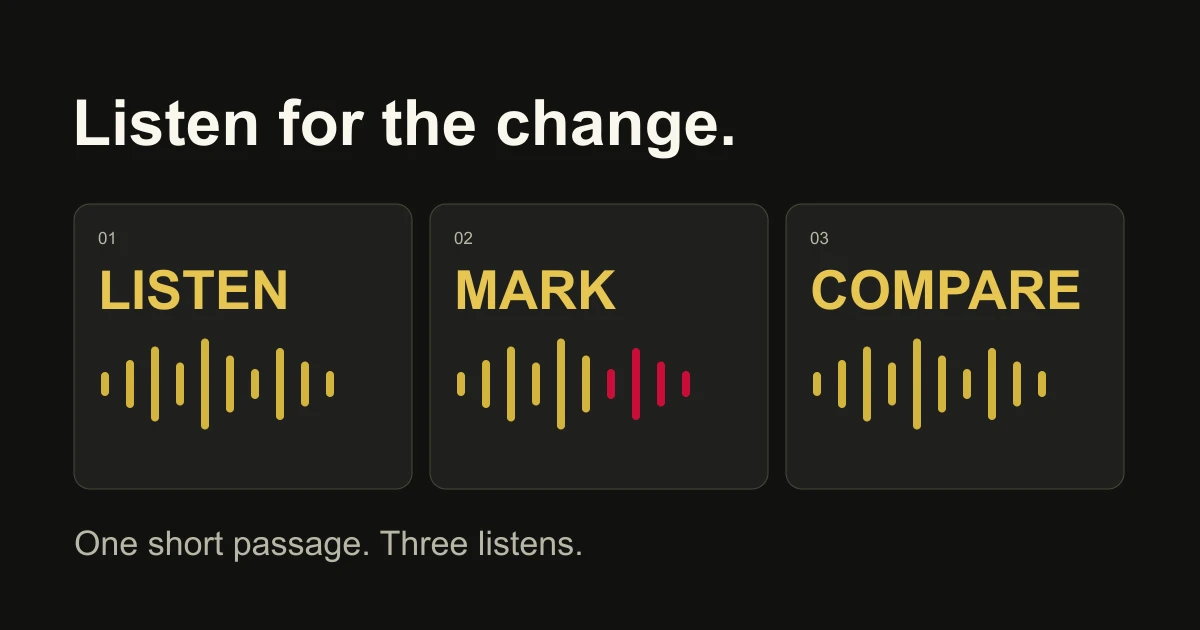
To hear a phrase change in Bachata, follow a musical idea until it seems to settle, then listen to what comes next. A sung line may reach an ending, the guitar may answer, or a familiar melody may return with a different finish. Counting can help you find that moment again; the sound gives you something to recognise.
Try this with "Dile al Amor" by Aventura, from the beginner Bachata playlist. Choose a sung passage with a few neighbouring lines. Listen to one line, let the next one play, then replay both. Does the first ending feel complete, or does the next line carry the thought further?
You can begin sitting down. Give your ears one small job before asking your feet to join in. If you can tap a steady beat already, you have a useful starting point for the practice below. If finding the beat is still difficult, begin with the Bachata musicality guide and come back when your tapping feels steadier.
An ending inside a bigger thought
A phrase is a connected musical idea with some sense of completion. It can be a short thought or part of a longer one, much as a clause can belong inside a sentence. Berklee's explanation of melodic phrases describes how resting, holding a note or reaching a resolution can help define an ending, and how shorter phrases can join into a longer phrase.
That is why two nearby endings can feel different. The first may give you a little resting point; the second may feel as though the whole thought has arrived. You can hear both without needing a new movement for each one.
The beat, or pulse, is what you tap underneath. Your count gives those beats numbers so you can organise your steps. A verse or chorus is a larger section that can hold several musical ideas. These are useful distinctions, but you do not need to label every part of the song before enjoying it.
Follow the voice and its answer
Start with the singer. Notice how a line rises, falls, holds or releases. You do not need to understand every lyric to hear that shape. When the voice rests, listen to the space after it. Does a guitar answer? Does another voice enter? Does the next line repeat something you recognise?
The lead guitar often plays in conversation with the singer, as Adam Taub explains in his Bachata instrument guide, in Spanish. Following that exchange gives you a manageable pair of sounds to listen to while the accompaniment continues.
A breath on its own may leave you unsure. Look for another clue: a repeated melody with a new ending, a change underneath the voice, or several sounds becoming quieter or more energetic together. Let the next few beats play. Sometimes what follows makes the earlier ending clearer.
An accent is a local emphasis, such as one guitar note standing out. A break is a more noticeable interruption or thinning of the groove. Either can draw your attention, but the musical idea may still continue after it. Ask, "What happened next?" before deciding how much has changed.
Three passes through your chosen passage
Keep the same passage for all three passes so you can become familiar with its sound.
1. Listen without managing your feet
Play through a few vocal lines. Follow the voice and listen to what fills its gaps. Choose one possible ending that catches your ear, then hear the beginning after it.
If the passage has no singing, follow a repeating guitar idea instead. You are looking for a sound you can recognise when it comes back.
Try to keep the passage small enough to remember, but leave room on both sides of the ending. Replaying only the last note removes the approach and the answer that help you understand it.
2. Mark what you actually heard
Replay from before your chosen moment. Write down its time in your recording and a plain description of the sound. Your note might be:
"The voice holds a note, the guitar fills the gap, then a similar vocal line begins."
Or it might be:
"The singer pauses here, but the next line seems to carry on the thought."
Those are example observations for your own listening. Use the time from your chosen passage so you can find it again. If you are unsure, write "possible ending" and keep the note. Uncertainty gives you a question to listen for on the next pass.
3. Compare it with another ending
Now tap the steady beat while you replay the passage. Notice what continues beneath the voice or guitar. More guitar notes do not automatically mean a faster beat; a held vocal note does not ask you to slow your tapping.
Choose another nearby ending and compare them. Does one feel more settled? Does the second line complete something the first left open? When the idea returns later, does it end in the same way or continue further?
Put your notes away, start a little earlier and listen again. See whether you recognise the moment by its sound. If both endings feel equally complete, try another passage. You have still practised following a musical thought and keeping the beat underneath it.
Add counting once you have something to hear
Replay your marked passage and count evenly from 1 to 8 as you have learnt for your basic. Notice where the possible ending falls. Then listen for another return and see whether a similar grouping helps you anticipate it.
Bachata does not have one standard song form, as the CUNY Dominican Studies Institute's Bachata genre guide explains. A grouping you hear in this passage may not fit your next song.
Counting can make a pattern easier to remember. Keep checking it against the melody: if you reach the place you expected but the idea still feels unfinished, let it continue. A count is useful when it helps you listen; it becomes less useful when you wait for a number and miss what the song is doing.
If you lose the count while following the voice, return to tapping for a replay. You can add the numbers again when those two jobs feel comfortable together.
Let the listening reach your basic
Stand up and replay the passage with a small, familiar side basic. Keep the step, step, step, tap on each side while you listen to the sound you marked.
Choose one small response. If the ending becomes softer, make your steps smaller. If the next idea arrives with more energy, let your basic feel more definite while keeping the same timing and a comfortable range. You could also let a tap feel clearer without stamping. Try one choice at a time so you can notice what happens to your feet.
If listening makes you rush, go back to tapping before stepping again. If you hear the ending but cannot decide how to respond, keep the same basic through it. Recognising the sound is useful on its own, and you have time to explore movement later.
With a partner, finish a movement already in progress. If you hear the ending during a turn, complete its familiar exit rather than pulling your partner into a sudden stop. Any change still needs comfortable preparation, shared balance and room to finish. Agree on what you want to try, and leave dips or unfamiliar movements out of this listening exercise.
Take one clear question with you
After the practice, see whether you can find the moment again, describe what you heard and keep your beat going through it. You do not need a perfect name for the ending. "The guitar answers here, but I cannot tell whether the next line continues the same idea" is already a useful question.
We can listen to that passage together in a private Bachata lesson in Dubai. You can come alone or with your partner; if you come alone, I can dance the other role while we explore a simple response in a shared basic.
If you are outside Dubai, a live online lesson lets us listen together and look at your visible timing and solo steps. The physical feel of leading and following still needs in-person partner practice.
For your next listen, keep the question small: "What makes this ending feel different from the one before it?" Give yourself a few replays, then enjoy dancing to the passage you now know a little better.