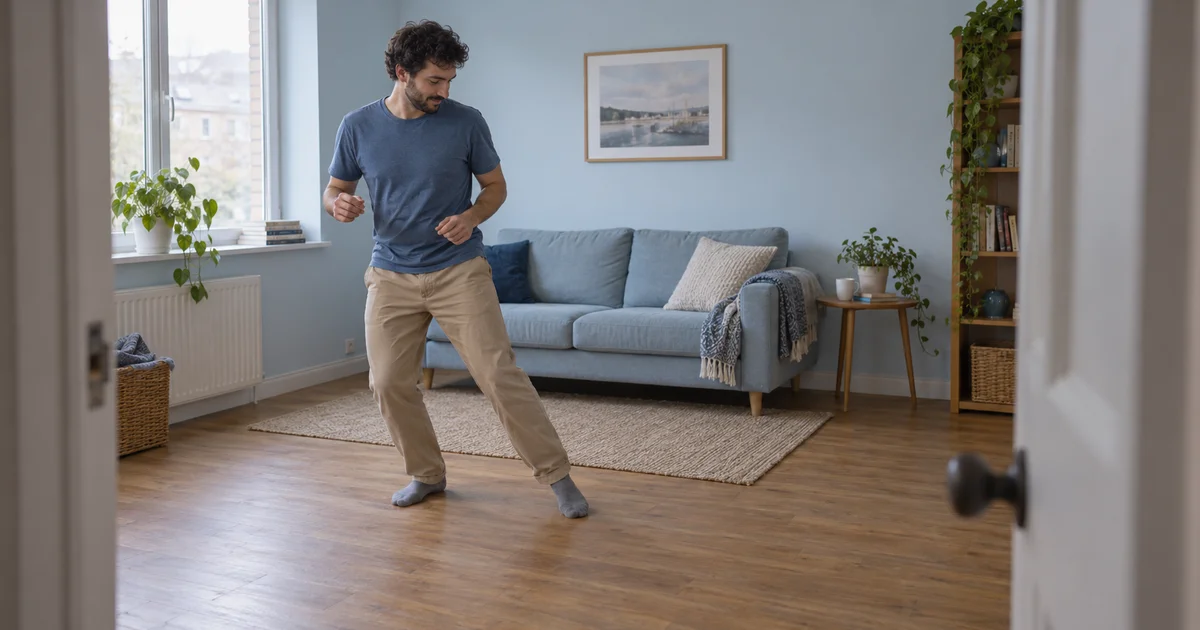
You can start learning Bachata at home when there are no suitable classes nearby. Begin with a beat you can tap, one side basic and clear weight changes. Those are useful foundations you can practise without another dancer.
For a first attempt, try side, together, side, tap, then repeat to the other side. Work without music while you learn the route, then add a passage whose beat you can follow. The full foot pattern below will help you see which step comes next.
Partner connection needs a person who can respond. You can prepare your own timing and movement alone, but a screen cannot give you the physical feeling of a lead or follow. Keep space for that experience when it becomes possible; you can still enjoy and develop the parts available to you now.
Find something steady to move with
Clear enough floor for small side steps without avoiding furniture. Choose footwear that feels secure on the surface. If the room is too crowded to move comfortably, listening is a useful practice for today.
Play a Bachata track and mark its pulse with your hand. Count from 1 to 8 if that helps you follow it. Let a short passage continue while you keep tapping. If the pulse disappears, stop the numbers and listen again before restarting.
Dance Dojo's counting lesson demonstrates a common beginner pattern: steps on 1, 2 and 3, tap on 4; steps on 5, 6 and 7, tap on 8. Use that counted example if your chosen song is difficult to follow. Your first job is to hear a steady pace, rather than recognise every instrument or predict each musical change.
Walk through one side basic
Here is one common beginner version, starting to your left. Teachers and styles may use other entries and variations, so keep this pattern together while you learn it.
- On 1: step left with your left foot and transfer your weight onto it.
- On 2: bring your right foot towards the left and transfer your weight onto the right.
- On 3: step left again and transfer your weight onto the left.
- On 4: tap the right foot lightly, keeping your weight on the left.
- On 5: step right with that free right foot and transfer your weight onto it.
- On 6: bring the left foot towards the right and transfer your weight onto the left.
- On 7: step right again and transfer your weight onto the right.
- On 8: tap the left foot lightly, keeping your weight on the right, ready to go left again.
Say "side, together, side, tap" if the words are easier to follow than numbers. Begin without music and keep the travel modest. You are learning the sequence, so give yourself room to remember it.
Let a step take your weight and a tap leave the standing leg supporting you. Keep the tap simple; you do not need to lift the foot high or manufacture a large hip movement. When you can repeat the route without searching for the next foot, add the clear passage you were tapping.
Notice the step after the tap
The change of direction can help you understand the pattern. After the right-foot tap on 4, that same foot begins the move right on 5. After the left-foot tap on 8, it begins the move left on 1.
Can the tapping foot move next without another weight change first? If you need an extra step, slow down and look at what happened before the direction changed. You may have put weight onto the tap or become uncertain about the sequence. Keep that as a question while you compare with the example.
"I tap on 4, then need another step before going right" is a useful observation. It describes something you can repeat and show, without deciding that all your dancing is wrong.
A mirror or recording may help you notice an extra step, but it does not always explain the cause. If the movement stays unclear, you can use that observation to ask for feedback.
Give a few practices different jobs
You can return to the same basic in three ways. These are possible practice sessions, rather than a timetable for how quickly you should learn. Repeat any part that helps.
Map the feet
Tap the pulse, then walk through the side basic without music. Say the counts or the movement words and notice the supporting leg after each tap.
Finish while you can still follow the route comfortably. Keep one note about the point where you needed the example again. Next time, try remembering that part before replaying it.
Bring in the music
Listen and tap first, then add your basic. Notice whether your feet keep the same pace when the melody becomes busy.
If your steps hurry, return to tapping and counting. Try the teaching example again if the track is still confusing. Keeping the movement familiar makes it easier to hear what changes when music is added.
Record one question
Use a securely placed phone with your full body and feet visible. Keep the original sound and record a short pass of the basic. Check the playback before practising more, so you know the feet and timing are clear.
Watch for one thing: an extra step after the tap, a tapping foot that cannot begin the next side, or steps that gradually travel farther. Keep the question that fits what you actually see. A less polished attempt can be more useful than repeatedly filming until the difficulty disappears.
Know what solo practice can tell you
You can work alone on hearing the pulse, changing weight, keeping steps controlled and remembering a familiar sequence. Later, suitable instruction can help you add solo footwork or a comfortable turn. Practising the return to your basic is part of using those movements, too.
Leave unfamiliar waves, head movements, dips and complex turns for appropriate teaching. A performance clip shows a finished dance; it may leave out the preparation and limits you need to learn it.
When a visible question keeps returning, live feedback may help. For example, your count might stay steady while an extra step appears between basics, or one direction may look different from the other. A teacher can watch an attempt and help you try a correction. Watching yourself again and again does not have to be your only option.
Partnerwork asks a different question: can another person comfortably understand and respond to your preparation? It also adds real floor awareness around moving people. You cannot answer those questions by rehearsing beside an imaginary partner or pulling against furniture.
When someone can practise with you
Start with material you both understand, rather than taking turns pretending to be the instructor. Agree on who will lead and follow for the attempt, choose a comfortable hold and ask before moving closer.
Keep only the shared basic at first. Use small steps, allow either person to pause and ask, "Does this timing feel comfortable?" Listen to what the other dancer noticed. A preparation that feels clear to you may need more attention when somebody else receives it.
If either person is guessing or the contact becomes forceful, return to solo practice or seek instruction. Leave unfamiliar partner movements out. The leading and following guide explains the roles, but the physical conversation still needs practice with a willing person.
If you later find a suitable class or workshop, tell the teacher what you have practised and how much partner experience you have. Good timing at home does not decide your partnerwork level. The first-class guide can help you prepare for that next step.
Get feedback from where you are
In a live online Bachata lesson, I can watch your full-body movement and work with you in real time on visible timing, posture, foot placement and solo transitions. We can begin with the basic that feels unclear and try an adjustment together.
When you enquire, include your level, timezone, preferred times, available floor space and what you have been practising. A question such as "I can repeat the basic slowly, but after the tap I need another step before changing direction" gives us a clear starting point. The online coaching guide can help you decide whether that format suits your goal.
A video call cannot supply physical lead-and-follow connection. For that part, plan suitable partner practice or in-person instruction when it becomes available.
For now, you can make the next attempt quite small: listen, find your feet and see whether the tapping foot is ready to begin the other side. That is real material to enjoy and build on at home.