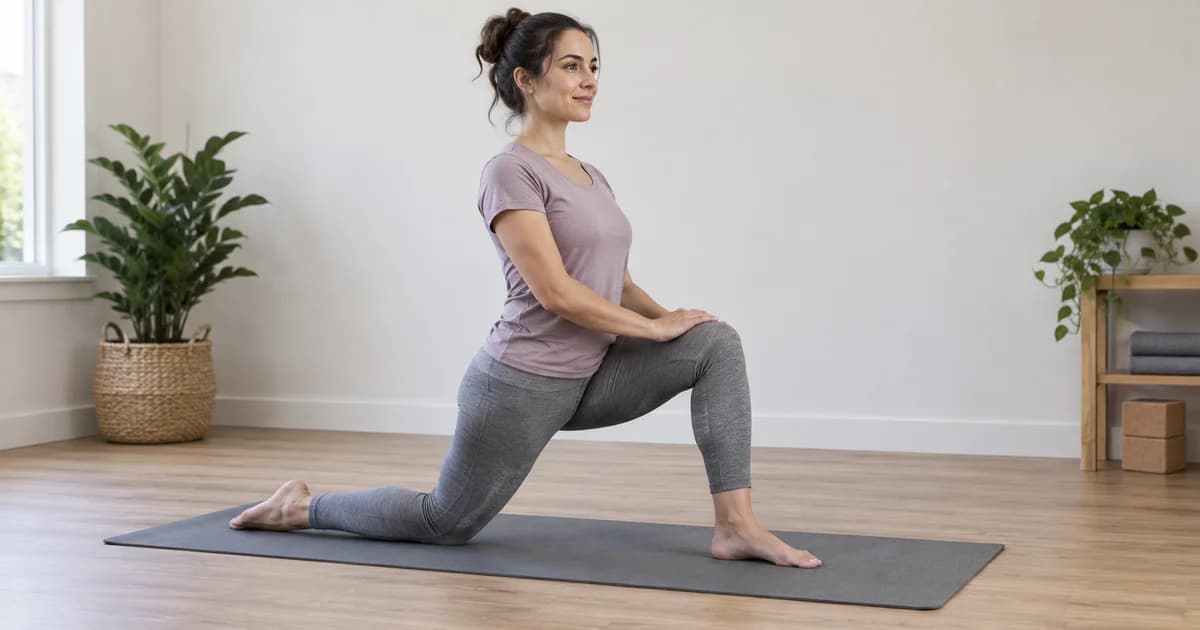
Hip practice is useful when it helps you move through a comfortable range you can control. For Bachata, that means keeping your balance as you shift weight or move your pelvis. A deep stretch is not the goal, and this routine is not a treatment for hip pain.
Start with a few minutes of easy walking or basic steps. Keep every movement small enough to breathe normally. Stop for sharp pain, pinching, numbness or catching; recurring symptoms need advice from a qualified health professional.
1. Small standing hip circles
Stand with feet about hip-width apart and knees soft. Rest your hands on your hips. Move the pelvis a little forward, to one side, back and to the other side, joining those directions into a small circle. Keep the chest quiet and the feet grounded. Reverse the direction.
If your knees twist or your lower back arches sharply, reduce the circle. This is a coordination drill, not a test of how far you can push your hips.
2. Supported leg swings
Stand beside a sturdy wall or chair and use one hand for balance. Keep the standing knee soft. Let the other leg move a short distance forward and back without throwing it or leaning your torso. Slow down enough that you can stop the leg where you choose. Change sides.
Use only a comfortable range. If you need momentum to lift the leg higher, stay lower. You should finish feeling ready to step, rather than tired from trying to reach a large shape.
3. Gentle knee-to-chest stretch
After you are warm, lie on your back. Bend one knee and bring it gently towards your chest, supporting the leg with your hands. Keep your lower back comfortable against the floor. Release slowly and change sides. Do not pull through hip pinching.
The AAOS hip-conditioning guide illustrates this exercise and gives a wider conditioning programme. Its instructions are general exercise guidance; they do not establish a Bachata-specific result or replace advice for an existing condition.
4. Comfortable half-kneeling hip-flexor stretch
Use padding under one knee and place the other foot in front, flat on the floor. Keep your torso upright, hips facing forward and hands resting on the front thigh. Gently tuck the pelvis under, then shift only enough to feel a mild stretch at the front of the rear hip. Avoid arching your lower back. Come out slowly and change sides.
The South Tees half-kneeling stretch guide shows the position. If kneeling is uncomfortable, skip this exercise and ask a qualified professional for a suitable alternative. Do not push through knee or hip pain.
Take the range back into your basic step
Stand up and try a small side-to-side basic. Transfer weight fully without swinging your torso or pushing for a larger hip action. Notice whether you can move and stop comfortably. The body-movement guide takes that control into isolation practice.
You do not need to complete every drill or follow a fixed ten-minute dose. Choose a movement you can perform calmly, repeat it while control stays clear, then return to easy steps. More range is useful only if you can use it without compensation.
Before class or in a separate session?
Use moving drills as part of a gradual warm-up. Gentle held stretches belong after you are warm or in separate flexibility work. IADMS warm-up guidance distinguishes dynamic preparation from static flexibility training: stretching alone is not a full warm-up.
For the whole before-and-after sequence, use the stretching routine. For strength alongside movement control, see core exercises for dancers.
Finish by checking a basic step you know. If a drill makes that step painful or harder to control, stop rather than treating discomfort as progress.