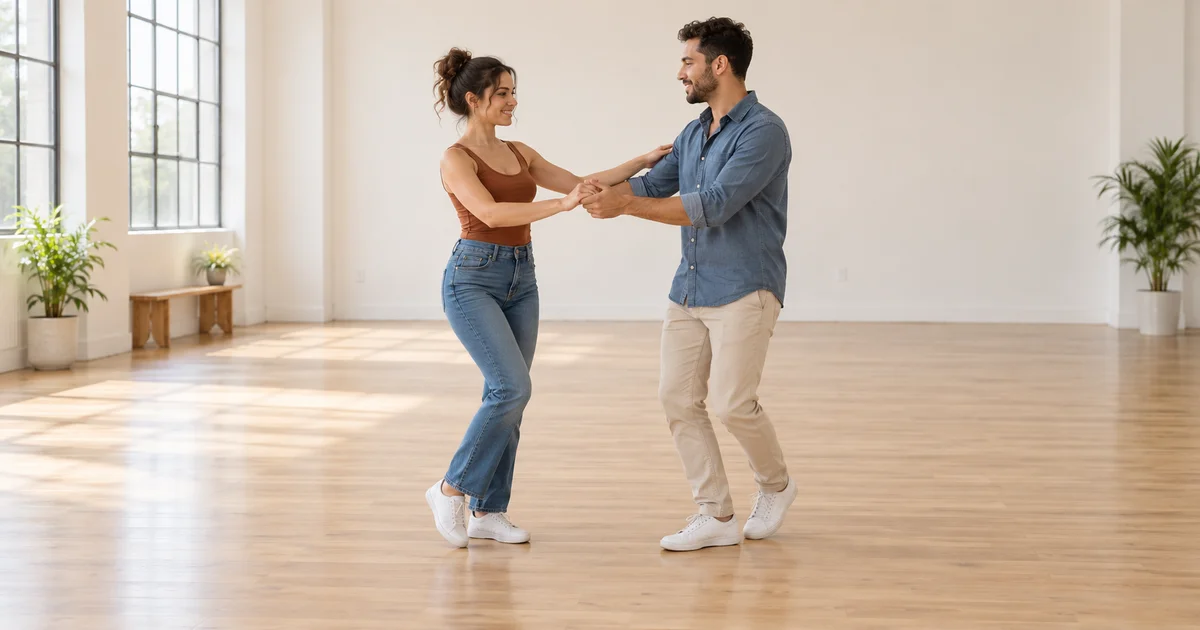
If you already know a Bachata side basic, a familiar direction change and one comfortable turn, you have enough material to practise a whole song. Begin with the basic, choose a change when the timing and space feel clear, then come back to the basic before choosing again.
Repeating a movement gives you time to hear the music and connect with the person dancing with you. You can enjoy that part of the dance. Every change in the song does not need a new combination.
Before trying this exercise, make sure you can keep your basic going to music, change direction without losing your balance, and complete a turn a teacher has shown you. With a partner, you should also be able to use a comfortable connection without pulling or gripping. If one of those still feels uncertain, begin with the movements you trust and practise that missing piece separately.
Choose your three moves
Keep the choices familiar:
- Your basic: the side basic you know best.
- Your direction change: one taught way to change the direction or orientation of your basic. A forward-and-back basic can be this choice if you have learnt how to enter and leave it.
- Your turn: one taught turn whose preparation and finish you recognise.
Use the versions you learnt in class, including their hand position and finish. This is a chance to use what you know comfortably across a song. Written instructions cannot supply the technique for an unfamiliar turn.
With a willing practice partner, agree on those choices before the music starts. Choose a hold and range that feel comfortable to both of you. Either dancer can ask to make the movement smaller, stay with the basic or stop. If the turn needs a harder grip or a hurried recovery step, leave it out for now and work with two choices.
Basic, check, choose, return
Let the basic be the place where you listen together and decide what happens next. Take this small loop into the song:
- Basic. Stay with it until your timing and connection feel settled.
- Check. Can you both complete it on shared timing? Is there room for the next movement and its finish? Is the familiar preparation comfortable, with time for your partner to respond?
- Choose. Use your direction change, use your turn, or repeat the basic. If either dancer is still correcting their feet, give yourselves another basic.
- Return. After the change, dance at least one complete basic before choosing again. Notice whether the next step is available without a pull or a rushed adjustment.
If you are following, you are making choices too: keeping your steps controlled, responding to the preparation you actually feel and saying when something is unclear. You do not have to guess a plan. The leading and following guide explains shared preparation and partner choice in more detail.
Try a first-song example
For your first attempt, try this order when the checks above feel clear:
Two basics, one direction change, two basics, one turn, two basics.
Each "basic" here means one complete basic as you learnt it. After that short sequence, let go of the order and use the loop to continue through the song.
For example, your timing is settled and there is room to prepare and finish the turn. You choose it, then find your basic again. A little later, the music grows louder, but your partner needs an extra step to meet your timing. Stay with the basic while you settle together. The direction change can wait.
On another song, you might use four basics before changing direction or leave the turn out entirely. The starting order helps you begin; your partner, timing and space guide the rest. You are not assigning a move to every verse or chorus.
Build it in three passes
Start on your own
Dance one song with just your basic and direction change. Keep going without stopping to search for another move. Notice whether your balance and timing remain steady when you switch between them.
Solo practice lets you check your own feet and movement memory. The next pass adds what you cannot feel alone: whether the change is clear to someone else.
Share two choices
With your practice partner, use only the basic and direction change for one song. Follow the loop and give each change a clear finish.
Afterwards, ask, "Did you know when the direction change had finished?" Listen to the answer before adding anything. If the finish was unclear, practise that transition together.
Add the turn
Now include the familiar turn when the timing, preparation and space allow it. Ask afterwards, "Did the basic feel settled again after the turn?"
If the turn makes everything that follows feel rushed, go back to the two-choice practice. You have found the part that needs attention. A whole song with two comfortable choices is still useful practice.
Find variety inside the basic
The same basic can feel different as you hear more of the song. When the music becomes softer, try a smaller step. As its energy grows, make the step more definite while keeping a comfortable range and the same timing. Small changes can give you something to enjoy without taking more floor space.
Extra taps, stops and timing changes affect what your partner expects. Learn how to communicate those before using them for variety. For this exercise, step size and energy give you plenty to explore within the movements you already share.
When something interrupts the dance
Your mind goes blank. Keep your familiar basic going. Take a breath, listen and let yourself repeat it for a few complete basics. You can choose again when you feel ready, or enjoy that basic through the rest of the song.
The turn works, but the return feels rushed. Shorten the practice to basic, turn, basic. Leave out the direction change while you work on that small unit. Notice where the turn finishes, which foot is available for the next step and whether you both recognise the finish at the same time. If you cannot identify the taught exit, ask your teacher to review it with you.
You lose the beat. Stop adding changes and make the movement smaller. If you need to pause, let your partner know, listen together and restart when you both find a clear place in the music. The guide to recovering when you lose the Bachata beat takes you through that problem more fully.
Your partner does something unexpected. Keep your own balance and reduce the movement while you find something you can share. A leader can let a planned turn go when the path changes. A follower can respond to the actual preparation and ask for a reset when it is unclear.
The floor becomes crowded. Use small basics and leave out the turn. Check the space around you again before changing direction. You can keep enjoying the music with less travel.
The song ends. Finish the movement you are already dancing and settle your balance. A simple ending and a thank-you are enough; save dips or unfamiliar movements for a time when you have learnt and agreed on them.
Notice what needs practice next
After the song, check three things:
- Could you keep dancing without stopping to search for a combination?
- Did the direction change and turn lead into a recognisable, comfortable basic?
- Can you name one transition that needs more attention?
Ask your partner about that moment too. Their answer may help you distinguish a finish that feels balanced on your own from one that feels clear to both of you. Keep the next practice focused on that detail.
Bring one clear question to a lesson
You can make a lesson request quite specific: "I can dance my basic and this turn, but I rush the first basic after the turn." That gives us a useful place to begin.
In a private Bachata lesson in Dubai, you can come alone or with your partner. I can dance the other role with you so we can look at the timing, preparation, step size, connection and finish around that difficult return.
If you are outside Dubai, I can help with visible timing, posture, foot placement and solo transitions through live online Bachata coaching. We work on those details together in real time. A video call cannot give you the physical feeling of another dancer leading or following, so shared connection still needs practice with a partner.